
Transfrom your Space with Natural Cobblestone
A premium, durable, and timeless stone solution for driveways, pathways, and outdoor spaces. Get expert to fulfill your needs
Get a free Quote📊 Comparison Table: Natural Stone vs. Cement Pavers
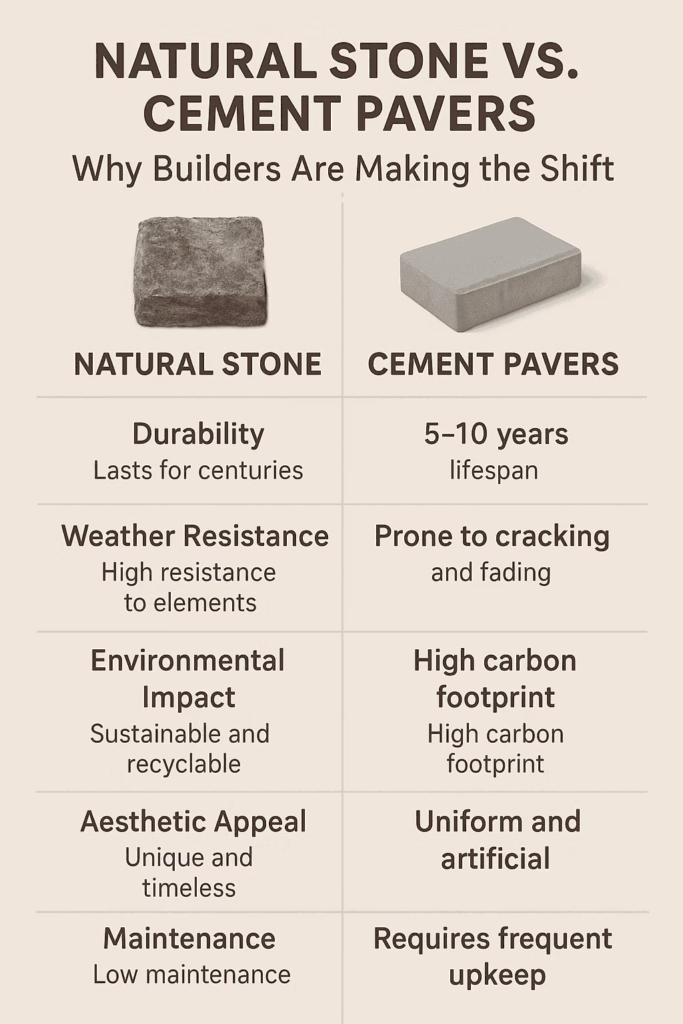
Feature | Natural Stone | Cement Pavers |
Durability | Lasts for centuries | 5–10 years lifespan |
Weather Resistance | High resistance to elements | Prone to cracking and fading |
Environmental Impact | Sustainable and recyclable | High carbon footprint |
Aesthetic Appeal | Unique and timeless | Uniform and artificial |
Maintenance | Low maintenance | Requires frequent upkeep |
Design Versatility | Wide range of styles and finishes | Limited customization |
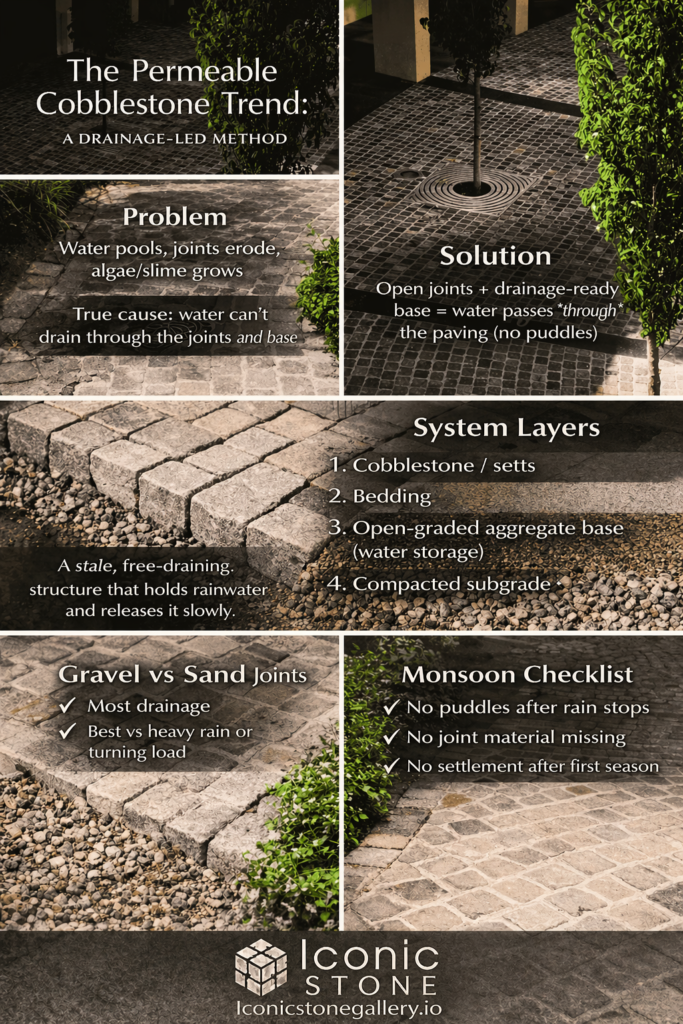
Why puddles happen in cobblestone driveways (the real reasons)
Puddles show up because one or more of these conditions exists:
Tight or sealed joints
If joints are packed with the wrong filler, or sealed with cementitious grout, water can’t enter the surface.
A base that traps water
If the base is made with fine material that holds moisture (or turns into slurry), water has nowhere to go.
No storage layer
A driveway needs a layer that can temporarily hold rainwater and release it slowly into the ground or toward a drain line.
Runoff from landscape hits the driveway
Water from lawns, planters, or ramps flows onto the driveway faster than the surface can shed it.
Edges are weak or missing
Without proper edge restraint, stones slowly move, joints open unevenly, and low spots develop.
Most people “solve” this by adding more surface slope or cutting drain channels later. That’s a band-aid. Permeable paving is the proper fix because it treats water as a design input from day one.
The “Monsoon-proof driveway” checklist
If your driveway passes these, it’s built right:
No standing water 20–40 minutes after rain stops (normal heavy rain)
No joint washout after the first 2–3 storms
No rocking stones after the first season
No green slime line at the lowest corner
No settlement near turning points and edges
Common mistakes that destroy permeability (and create future repair work)
Mistake 1: Using fine “dusty” filler in joints
It compacts and seals the joint, reducing permeability.
Mistake 2: Cementitious grouting in the name of “stronger joints”
It blocks infiltration and tends to crack under driveway movement, then traps dirt and stains.
Mistake 3: A base made with mixed fines
Water turns the base into slurry. Settlement follows. Low spots appear.
Mistake 4: No edge restraint
Even the best stones will migrate under vehicle load if edges are not locked.
Mistake 5: Ignoring runoff direction from landscape
Permeable driveways handle rain well, but concentrated runoff needs planned dispersion (otherwise it can erode joints).
Maintenance: what owners should expect
A good permeable cobblestone driveway is not high-maintenance. But it has a predictable “settling phase.”
First season: minor joint topping is normal as everything locks in
Ongoing: occasional sweeping + topping where required
Long-term: fewer repairs compared to sealed systems, because water does not sit and rot the joints
The goal is not to eliminate maintenance. The goal is to eliminate failures.
Why this is the future of luxury driveways
Luxury is not only appearance—it’s performance that stays beautiful.
Permeable cobblestone driveways:
stay cleaner because water doesn’t stagnate on top
remain safer with better grip and fewer slimy patches
reduce drainage clutter (less dependence on visible channels)
last longer because the base is stable and water-managed
When you design the driveway to drain through the surface, you stop puddles at the root cause—without making the driveway look like a “civil drainage project.”
FAQ’s
1) Will weeds grow in permeable joints?
Weeds come from organic debris collecting in joints, not from water itself. With the right joint fill and periodic sweeping, weed growth is manageable and far less than poorly sealed joints that crack and trap dirt.
2) Do gravel joints come out in heavy rain?
If joint material is correct and edge restraint is proper, gravel joints hold well. Early top-up can be needed after the first settling cycle.
3) Can permeable cobblestones handle cars and SUVs?
Yes—when the stone thickness and base build-up match the load. Driveway performance depends more on base design than on surface appearance.
4) Is permeable paving better than adding a drain channel?
A channel manages runoff after water reaches it. Permeable paving prevents water from needing to run across the surface in the first place. Often, the best projects use both intelligently.
5) Will it work on a sloped driveway?
Yes—slopes just need better control of water flow direction and stronger edge restraint because gravity increases movement and runoff intensity.